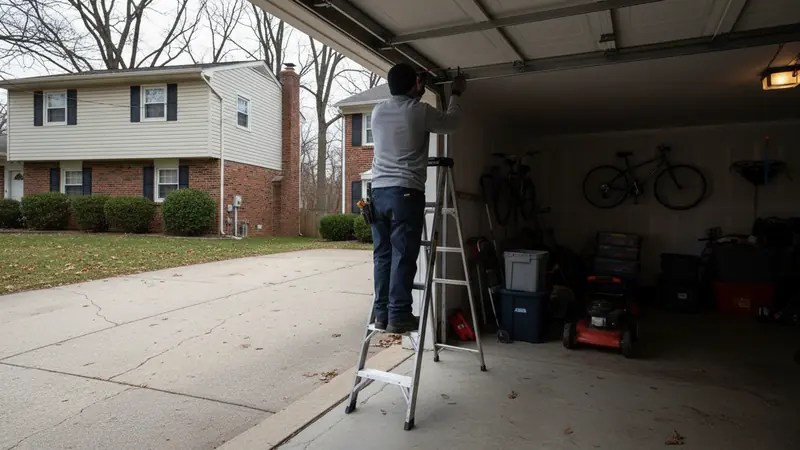
What you need to check when a garage door fails in Howard County. What permits cost. What to check in an older garage.
Each figure comes with the date we gathered it. Check the sources for effective dates. They also explain what the figures cover.
Do you actually need a permit?
Replacing a door and changing its opening are different jobs. Howard County's adopted building-code amendments exempt replacement windows or doors on existing single-family dwellings. The rough opening must stay the same size. Widening it falls outside that exemption.
Removing the centre support between garage bays changes more than the door. You are changing the building too. Before you authorise construction, tell DILP what will change about the opening, header or supports.
The wording has a limit. The exemption says doors. It does not name overhead garage doors or opener replacements separately. We read it as covering door-only replacements in unchanged openings at existing single-family dwellings. We cannot extend that reading to structural repairs, separate garage buildings, new wiring or floodplain work. Check those jobs with DILP at 410-313-2455, option 4. Explain whether the opener uses an existing outlet or needs electrical alterations.
We found no county handout saying which spring, cable or opener repairs need a permit. That does not mean every repair needs one. It does not mean none does, either.
Source: Howard County Council, CB24-2025 final amended bill, door-replacement exemption, effective 2025-09-07; Howard County DILP, FY2027 Building Permit Fee Schedule and permit-office contact, effective 2026-07-01. Gathered 2026-09-22.
What the permit costs
There is no garage-door-specific fee in the county's FY2027 building schedule. These charges apply if DILP classes your job as an alteration or repair to an attached or detached single-family dwelling:
| Item | Published fee |
|---|---|
| Nonrefundable filing fee | $25 |
| Small room or work area of 200 square feet or less | $50 |
| Larger work area, over 200 square feet | $100 |
| Technology surcharge | 10% |
These permit charges are separate from your contractor's labour and materials.
Check the category before adding up fees. The schedule uses work-area size, not door width or door count. It does not explain how DILP measures the area when you alter an opening. Do not use the door panel's surface area to choose the lower fee. These fees assume your work falls in the dwelling-alteration category. Ask DILP to confirm your project's category. Ask how it measures the area too.
The administrative schedule calculates the technology surcharge as a percentage of the licence or permit fee. It does not make clear whether that includes the separate filing fee. We cannot give you an all-in permit total. The permit office can confirm the category and area at 410-313-2455, option 4. It can also explain how the surcharge applies.
You may face extra administrative charges if your plans change after approval:
| Event | Published charge |
|---|---|
| Residential/trade revision after the first application revision, or any revision after approval for issuance or issuance | $50 |
| Extension, with written justification | $50 per 90 days, extensions totaling no more than one year |
| Second failure of the same inspection | $100 |
| Third failure of the same inspection | $125 |
| Fourth or subsequent failure of the same inspection | $175 |
| Work commenced without a required permit | $100 |
Ask for your estimate to say who pays revision charges. Settle who pays for reinspections too. The county sets the charges. Your contract decides who pays them.
Source: Howard County DILP, FY2027 Building Permit Fee Schedule and FY2027 Administration schedule, Council Resolution 83-2026, both effective 2026-07-01. Gathered 2026-09-22.
How long the permit actually takes
We could not find a primary source for Howard County's garage-door permit turnaround. Figures for new garages, all residential alterations or another trade would answer a different question. We cannot promise an approval time.
The county does explain how to apply. Submit residential building applications electronically through Citizen Access. Its miscellaneous/addition checklist asks you to describe the work accurately. Include drawings or specifications suited to the job. Give contractor details where required. You may apply without the professional registration form if you act as general contractor at your primary residence.
If you are altering an opening, show what is there now. Show the proposed opening too. Include any framing changes. This helps explain your job. It does not mean the county requires the same drawings for every door repair. The checklist also asks for condo or HOA approval letters where applicable.
An application receipt is not an issued permit. The county's Licenses & Permits Division says its issuance email includes a PDF of the permit. You can search Citizen Access by address or permit details. Check the record yourself if someone says “the paperwork is in.” Ask your installer when they expect county approval. Ask separately about product delivery. Check when they can fit the door too.
Source: Howard County DILP, Residential Miscellaneous and Addition Building Permit Checklist, revision 2023-12-18; Licenses & Permits Division, undated; Citizen Access permit search, live service. Gathered 2026-09-22.
Historic review can matter even when the opening stays put
A door that fits the existing opening can still change your building's appearance. If your property needs Howard County historic review, settle the proposed material before ordering. Agree the panel pattern too. Settle the glazing as well.
The Historic Preservation Commission reviews exterior alterations within local historic districts. It publishes separate design guidelines for Ellicott City and Lawyers Hill. An Ellicott City mailing address does not establish that your property is in the local district. Check your address against the historic designation.
The county says HPC application submissions have no fee. Staff may be able to decide a minor alteration through the staff determination process. That includes a five-day posting period. Objections during that period can send it to the Commission. For Commission review, the published application deadline is 22 days before the meeting. These timings describe the process. They do not guarantee approval within that time.
A broken door does not tell you which review route applies. We cannot assume your replacement qualifies as a minor alteration. The county directs emergency questions to preservation staff at 410-313-2350 or through its HPC page. Send photographs so staff can see the change. Give them details of your proposed replacement too.
Source: Howard County Department of Planning and Zoning, Historic Preservation Commission, minor alterations and 2026 meeting/application schedule, no separate policy effective date stated. Gathered 2026-09-22.
The inspections
The county's published inspection-code list has no separately named garage-door inspection. For permitted work, the inspection order depends on what was approved. These listed codes may be relevant:
- 209 — Frame
- 205 — Final Building
- 305 — Residential Rough Wire
- 304 — Final Electric
These are available inspection types. Not every door replacement needs all of them. Check which inspections you need before covering changed framing or wiring.
Once your permit is issued, you can request an inspection for the next day. You can also book up to seven working days ahead. Requesting a date does not guarantee an immediate visit for an emergency repair.
You can book by phone at 410-313-3800. Alternatively, text Schedule to 888-297-9841. Follow the prompts. You can get results through the phone system or Citizen Access on the day of inspection.
For a two-hour inspection window, call 410-313-1823 between 7:30 and 8:30 a.m. on the scheduled day. Ask questions about the required building inspection at 410-313-1810. For electrical questions, call 410-313-1820.
Source: Howard County DILP, Automated Inspection Request and Permit Information System / SelecTXT brochure, county-linked file marked modified 2026-04-28; introductory sheet retains a 2024-12-27 footer. Gathered 2026-09-22.
Which code applies, and what the inspector checks
Howard County lists the 2024 International Residential Code with county amendments, effective September 7, 2025. It also lists the 2023 National Electrical Code with local amendments, effective June 3, 2024. Use the county's adopted-code links when discussing a new alteration. An older installation manual alone cannot tell you which code applies. Neither can an undated checklist.
The county's residential framing checklist checks headers and girders against approved drawings, code and manufacturer details. It requires approved plans on site. You also need the manufacturer's specifications there. These checks matter if you change the beam above the opening or its supports. A new door fitting underneath does not prove that the changed structure is adequate.
The final building checklist checks that the required separation wall at an attached garage is complete. If your installation disturbs it, a cosmetic patch does not restore the required assembly.
Read the electrical checklist carefully. Its garage paragraph describes GFCI protection with exceptions for some receptacles. The webpage is undated. It does not name its electrical-code edition. We use it to identify what inspectors check. We cannot use it to say a ceiling opener outlet is exempt from GFCI protection. Check the current requirement for your electrical work with the electrical inspection office at 410-313-1820.
Source: Howard County DILP, Adopted Codes, effective dates as stated above; Inspection Requirements, Residential Building—Framing/Final and Electrical—Garage Inspections, undated; inspection contact brochure, file marked modified 2026-04-28. Gathered 2026-09-22.
Who is allowed to do the work
Hiring a business to repair or replace part of your existing home? Look for a Maryland Home Improvement Commission contractor license. Maryland's legal definition covers residential repairs and replacements. It also covers adjacent structures. It specifically includes garages.
Check the contracting business through the licence-search link on MHIC's official page. Match the business on your estimate to the licence record. A familiar truck logo is not that record. Another business's licence number does not answer the question either.
Maryland lets subcontractors work for an MHIC-licensed contractor without their own home-improvement licence. What matters is who contracts with you. MHIC says only its licensed contractors may enter those home-improvement contracts.
The required general liability insurance is at least $500,000, effective June 1, 2024. The Commission's Guaranty Fund covers work by licensed contractors, subject to its claim rules. You still need clear terms for the work. Settle the warranty terms too.
Do not assume these residential rules apply unchanged to a shared condominium garage. MHIC excludes commonly owned condominium areas from its stated coverage. It also excludes buildings containing four or more single-family units. Check the licensing requirements before you contract for common-property work.
Source: Maryland General Assembly, Business Regulation §8-101, home-improvement definition, current text; Maryland Department of Labor, MHIC licensing, scope, subcontractor and insurance notices, insurance requirement effective 2024-06-01. Gathered 2026-09-22.
What Howard County houses are, and what that means for a failing door
The 2024 ACS one-year estimates put Howard County's housing stock at 126,789 units. That includes 63,578 detached single-unit homes. Another 29,116 attached single-unit homes are included. The largest construction decade is 1980–1989: 27,137 units, or 21.4% of the total.
Those are survey estimates. The published margin of error for detached homes is ±2,508. For attached homes it is ±2,351. For the construction-decade count it is ±2,154. The figures count housing units, including vacant ones. They do not count garages or installed doors.
Check your equipment's history before assuming it is original. A house from that period could have a recent opener. Its door could be older. Its framing could be older still. Ask for the opener's model label. Ask for its installation paperwork too. Keep those details separate from the house's construction date.
We found no county-specific primary-source series ranking broken springs, failed openers, damaged tracks or deteriorated door frames. We cannot say which is Howard County's most common garage-door failure.
An older opener does give you something specific to check. CPSC says openers manufactured or imported for sale after January 1, 1991 must have reversing systems. External entrapment protection was added in 1993. A working remote alone does not prove those protections work.
CPSC advises you to inspect the door and opener every 30 days. It also advises testing reversal with a 2×4 board in the door's path. Follow your owner's manual for the procedure. If the door fails to reverse, stop using the automatic opener until it is properly adjusted, repaired or replaced. For photoelectric protection, CPSC's alert specifies fitting it 4–6 inches above the floor.
Apply these safety checks to the equipment you have. They do not tell us what share of Howard County homes has unsafe openers. An older house alone does not mean its door needs replacing.
Source: U.S. Census Bureau, 2024 ACS one-year Selected Housing Characteristics for Howard County, reproduced by the Maryland Department of Planning, page 8; U.S. Consumer Product Safety Commission, Safety Alert 523: Non-Reversing Automatic Garage Door Openers Are a Hazard, undated alert describing the 1991 and 1993 requirements. Gathered 2026-09-22.
An older painted door needs a different removal plan
For a pre-1978 home, check the painted surfaces your replacement will disturb before demolition starts. EPA says sanding, cutting and similar renovation work can release hazardous lead dust. The house's age is a reason to check. It does not prove your garage door's paint contains lead.
EPA's garage-door FAQ addresses removal without disturbing paint. A contractor may unbolt and remove a door without disturbing painted surfaces on the door, hinges or frame. In that case, EPA says the Renovation, Repair and Painting rule does not apply to that activity.
The companion FAQ explains how to count the area when you remove painted components and disturb paint. You count the surface area of the removed components. For a whole sectional door, that means adding up all its panels. That still applies if you disturb paint on just one panel.
For exterior work, EPA describes a less-than-20-square-foot minor-repair exception. Its definition has other conditions too. It is not a blanket exemption for each panel. Repairing a single panel can therefore have different implications from removing a whole door.
Ask whether removing the door will disturb paint. Check which components will come out. Settle how any required lead-safe work will be done. Resolve those details before workers scrape trim or cut painted framing.
Source: U.S. Environmental Protection Agency, RRP Program: Consumers, current guidance; garage-door removal without paint disturbance, FAQ 23002-19760; sectional garage-door surface-area calculation, FAQ 23002-31779, updated 2025-10-31. Gathered 2026-09-22.
What the work is worth, and how to read the quote
We could not find a Howard County installed-price series for spring repairs, opener replacements or complete garage doors. We cannot give you a sourced local price range, labour rate, service-call charge or resale-return percentage.
You can check whether competing estimates cover the same work. For a replacement, ask each estimate to name the door model. Check the finish. Check the glazing too. Ask which tracks and hardware are included. Check what opener you will get. Ask whether the price covers removal and disposal. Check for electrical alterations. Ask about framing repairs. Have any parts you will keep listed explicitly. A low quote might simply cover less work.
For a repair, ask for a written diagnosis naming the failed component. Have it explain why the proposed work fixes the problem. Ask whether the price includes checking operation afterwards. Check whether it includes testing safety features too. These questions still help when you do not need a county permit.
Maryland requires a legible written home-improvement contract. Both parties must sign it. It must describe the work and materials. It must name the contractor. It must give the MHIC number too. It must give an approximate start date. It must also give an approximate substantial-completion date. You must receive a signed copy before work begins.
The contractor may not accept more than one-third of the contract price as a deposit. They may not accept any payment before signing. You can negotiate later payment terms. Ask your contract to explain how newly discovered framing damage will be documented before the job expands. Settle how that extra work will be priced too. A county fee schedule cannot settle those terms for you.
Source: Maryland Department of Labor, Maryland Home Improvement Contracts, current guidance, no separate effective date stated. Quote-comparison questions are homeowner guidance, not a published county price schedule. Gathered 2026-09-22.